A2P 10DLC Registration Explained: What Every GoHighLevel User Needs Before Sending SMS
If you’re planning to send text messages from GoHighLevel — appointment reminders, lead follow-up, promotions, anything — there’s a compliance step that has to happen first, and skipping it is one of the most common reasons business SMS silently stops working. It’s called A2P 10DLC registration, and it’s not optional if you’re texting US phone numbers from a business account.
Here’s what it actually is, why it exists, what the process looks like inside GoHighLevel, what determines how fast and reliably your messages get delivered, and what happens if you skip it or get it wrong.
What A2P 10DLC actually means
“A2P” stands for Application-to-Person messaging — texts sent by software (like GoHighLevel) to an individual person, as opposed to “P2P” (person-to-person) texting between two phones. “10DLC” stands for 10-Digit Long Code, the standard local-format phone number most US businesses use to send these messages, as opposed to short codes (5–6 digit numbers) or toll-free numbers.
Major US wireless carriers created the A2P 10DLC system to distinguish legitimate business messaging from spam. Before this system existed, businesses could send bulk texts from ordinary-looking phone numbers with no registration at all — which is also exactly what spam and scam operations did. Carriers responded by requiring businesses to register their identity and their intended messaging use case before high-volume texting from a 10-digit number is allowed to go through at full speed.
Why this matters even if you only send a few texts
It’s tempting to think this only applies to businesses blasting thousands of messages a day. It doesn’t. Carriers apply throughput limits and filtering to unregistered numbers that are far stricter than most people expect — an unregistered number might get only a handful of messages through per minute before others start silently failing, and even the ones that do go through are more likely to be filtered as spam by the receiving phone’s carrier.
Registering doesn’t just raise your sending limits — it also improves deliverability for every message you send, even a single one-off text, because carriers treat registered, verified business traffic with more trust than unverified traffic from the start.
The two-part registration process
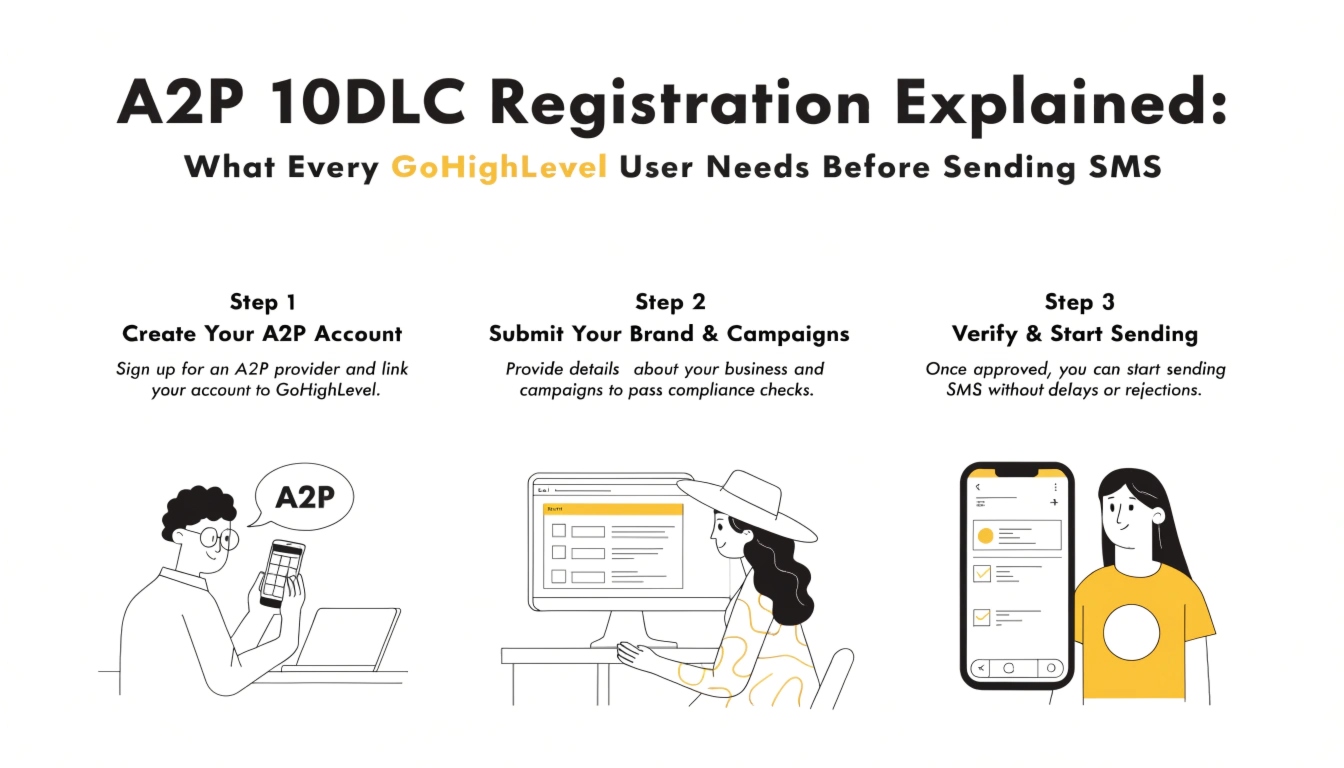
A2P 10DLC registration happens in two stages, and both need to be completed before your messaging behaves reliably.
Brand registration
This registers your business itself with The Campaign Registry (the industry body that manages A2P 10DLC), through your platform (GoHighLevel, in this case). It requires standard business information: legal business name, business type (LLC, corporation, sole proprietor, nonprofit, etc.), tax ID / EIN, physical address, and a contact person.
Carriers use this information to assign your business a trust score, which directly affects your messaging throughput. Established businesses with a verifiable legal entity, matching business details across records, and a real EIN generally receive higher trust scores — and therefore higher sending limits — than newly formed entities or businesses with mismatched or incomplete information.
Trust score tiers, roughly speaking, work like this:
| Brand Profile | Typical Trust Level | Practical Effect |
|---|---|---|
| Verified EIN, matching business records, established entity | Higher trust | Higher daily throughput, fewer filtering issues |
| Sole proprietor / unverified EIN | Moderate trust | Lower throughput ceiling, more conservative filtering |
| Incomplete or mismatched information | Low trust or rejected | Very limited throughput, higher chance of messages being blocked |
Common brand registration mistakes:
- Business name on the registration doesn’t exactly match the legal name on file with your EIN
- Using a personal address or a virtual mailbox address that doesn’t match business records
- Sole proprietors registering as a different business type than they legally are
- Submitting a business website URL that doesn’t clearly describe the actual product or service (carriers check this)
Any of these can lower your trust score or cause the registration to be rejected outright, both of which delay your ability to send SMS reliably — and a rejected brand has to be corrected and resubmitted, adding real time to your launch timeline.
Campaign registration
Once your brand is registered, you register a campaign — a description of how you intend to use SMS. Carriers offer several standard campaign categories, and the one that matches your actual use case matters:
Choosing a campaign type that doesn’t match your actual messaging content is a common reason for later filtering or suspension — for example, registering as “low-volume mixed” and then sending large promotional blasts can get flagged, because your actual traffic doesn’t match what you told the carrier you’d be sending. If your use case genuinely changes later (you start running bigger campaigns than when you first registered), it’s worth re-registering the campaign rather than letting the mismatch continue.
What this looks like inside GoHighLevel
GoHighLevel has A2P 10DLC registration built into its phone/SMS settings, which handles the technical submission to The Campaign Registry on your behalf. The general flow is:
- Enter your legal business details in the brand registration section
- Select the campaign type that matches your intended use
- Submit for carrier review
- Wait for approval (this can take anywhere from same-day to a couple of weeks, depending on carrier review queues and whether your submission has any issues)
- Once approved, your registered 10-digit number(s) are cleared for standard A2P throughput
Exact fees and current processing times change periodically as carriers adjust their systems, so it’s worth checking GoHighLevel’s current documentation or your account rep for up-to-date numbers rather than relying on a fixed figure — but budgeting for a modest one-time registration cost plus a small recurring carrier fee per registered number is standard across the industry, not specific to GoHighLevel.
Read this: The Complete Guide to GoHighLevel CRM Setup (2026)
How to know if your registration actually went through correctly
Submitted isn’t the same as approved, and approved isn’t automatically the same as working correctly. Before relying on SMS automations in production, it’s worth explicitly checking:
Testing across more than one carrier matters because filtering behavior isn’t identical across all US carriers — a message can go through cleanly on one network and get delayed or filtered on another, especially in the early period right after registration while trust is still being established.
What happens if you skip it
Unregistered numbers sending A2P-style traffic (automated messages from a business, at any real volume) will typically experience:
That last point is the one that causes the most confusion — a business will assume their reminder sequence is working because the platform shows the message as “sent,” without realizing carriers are silently failing to deliver a meaningful share of it. The first sign of a skipped or failed registration is often a client mentioning they never got a text they were supposed to receive, weeks after the automation went live — long after the person who built it has moved on to the next project.
A note on toll-free and short code numbers
A2P 10DLC specifically applies to standard 10-digit local numbers. If you’re using a toll-free number for SMS instead, there’s a separate (though similarly required) toll-free verification process, which has its own timeline and its own set of business information requirements. Short codes involve their own, more involved application process typically reserved for very high-volume senders and usually take considerably longer to approve.
Most small and mid-size businesses using GoHighLevel are working with standard 10-digit numbers, which is what this guide covers — if you’re specifically using a toll-free number, the registration steps are different even though the underlying goal (carrier trust and deliverability) is the same.
Read this: The Ultimate Guide: GoHighLevel for Marketing Agencies (2026)
Common questions
How long does approval actually take?
It varies. Straightforward brand registrations with clean, matching business information are often approved within a few business days. Registrations with any mismatch or missing information can take substantially longer, since they may require manual review or resubmission after correction. Building in buffer time before a launch date that depends on SMS working is worth doing rather than assuming same-day approval.
Can I send any SMS at all before registration is approved?
Technically, yes — GoHighLevel doesn’t block you from sending before approval. Practically, you should expect low throughput and unreliable delivery until approval is complete, so sending time-sensitive automations (appointment reminders, for example) before registration is finished is not advisable.
What if my business is brand new with no sending history?
New businesses can still register and typically start at a more conservative trust tier with lower throughput limits. This isn’t a permanent ceiling — trust and throughput generally improve over time as a clean sending history builds up, assuming there are no spam complaints or compliance issues along the way.
Do I need to re-register if I add a second phone number or open a new location?
Additional numbers under the same registered brand typically need their own campaign association, though they benefit from the brand-level trust already established. Multi-location businesses should plan for this as part of the setup rather than assuming one registration automatically covers every number added later.
What’s the single most common cause of registration problems?
Mismatched business information — the name, address, or entity type on the A2P registration not exactly matching what’s on file with the IRS/EIN records. This is the easiest thing to get right and the most common thing to get wrong.
The practical takeaway
If SMS is part of your GoHighLevel setup at all — reminders, follow-up sequences, promotions — A2P 10DLC registration isn’t a nice-to-have compliance formality, it’s the difference between automations that actually reach people and automations that quietly fail while looking like they’re working. It’s also one of the easiest things to get wrong during a rushed or budget setup, because it doesn’t produce any visible error until messages start failing to deliver weeks later.
Getting the brand information exactly right the first time, choosing the correct campaign type for your actual use case, confirming registration is fully approved (not just submitted) before relying on SMS automations in production, and testing delivery across more than one carrier is the difference between a system that works reliably from day one and one that needs to be debugged after a client has already noticed something went wrong.