White-Label GoHighLevel: A Realistic Revenue Model for Agencies
If you run a marketing agency and you’ve heard other agency owners talk about “reselling GoHighLevel” as a recurring revenue stream, the pitch usually sounds simple: rebrand the software, sell it to your clients, collect monthly fees.
The reality is more nuanced it’s a genuinely good model for the right kind of agency, and a distraction for the wrong kind. Here’s what actually determines which one you are.
What white-labeling GoHighLevel actually means
White-labeling isn’t just changing a logo. It means you operate your own branded version of the platform your domain, your name, your login page — while GoHighLevel’s infrastructure runs underneath it. Your clients never see “GoHighLevel” anywhere; they see your software. You set your own pricing, create your own onboarding process, and are the sole point of support your clients interact with.
Structurally, this puts you in a software-reseller position rather than a pure services position. You’re not just billing for hours of setup work — you’re building a recurring line item that exists independent of any single project.
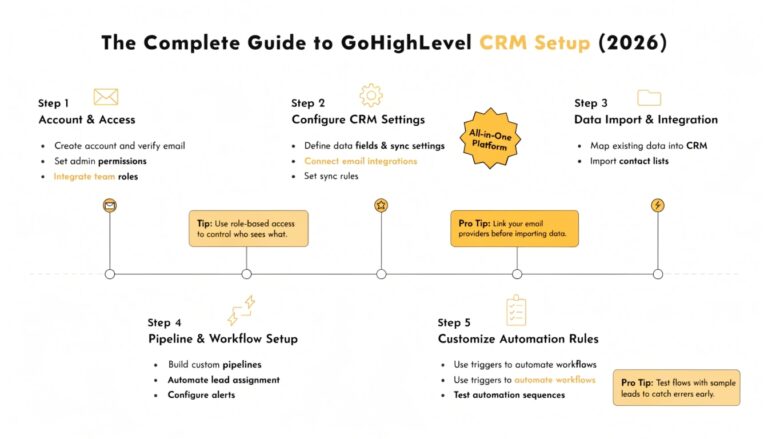
Read this: The Complete Guide to GoHighLevel CRM Setup (2026)
The realistic revenue math
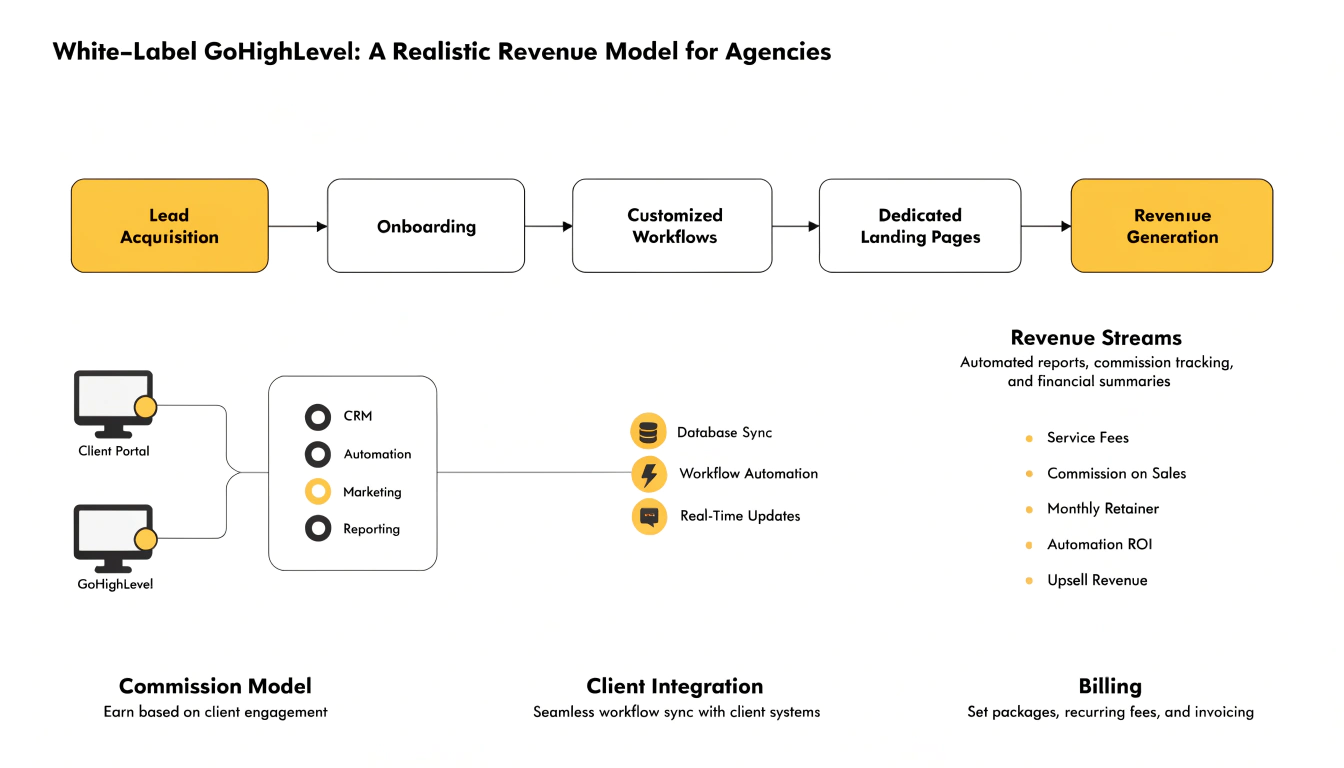
Agencies typically pay GoHighLevel a wholesale rate per sub-account (the individual client instance under your master account), then charge clients a marked-up monthly fee for access to their branded platform, often alongside setup and management services.
The margin isn’t in the software resale alone — it’s usually modest per account. The real economics come from bundling: software access plus the setup, automation, and management work that makes the platform actually useful to a client who wouldn’t build it themselves. A client paying for “our CRM platform” at a reasonable monthly rate, where you’ve also built their pipelines and are maintaining their automations, produces meaningfully more revenue per client than the software fee alone — and it’s revenue that doesn’t require re-selling the relationship every month the way one-off project work does.
Where this breaks down: agencies who expect the software resale margin by itself to be the business. At small client counts, the per-account margin rarely covers your own overhead, support time, and the effort of learning the platform deeply enough to support clients competently. This model works because of the recurring relationship it enables, not because reselling software licenses is inherently profitable at low volume.
What makes this work well
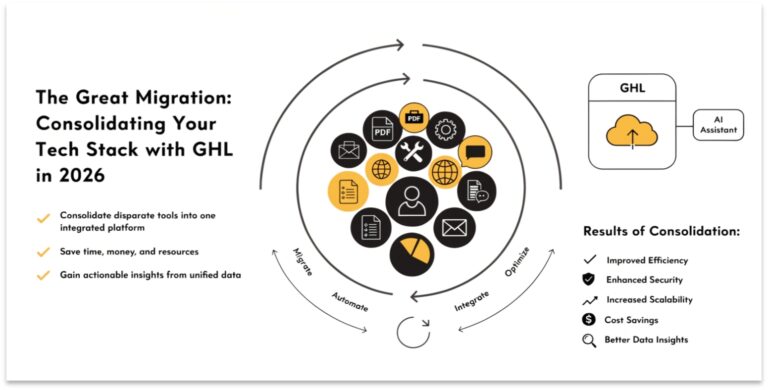
You already have client relationships. White-labeling is strongest for agencies that already run marketing, sales, or operations for clients and want to consolidate the tools those clients are paying for into one recurring platform under your brand, instead of clients separately paying for a CRM, an email tool, and a scheduling app.
You’re willing to actually support the platform. Clients will treat you as their software provider, which means support requests, troubleshooting, and “why isn’t this working” questions become your responsibility — not GoHighLevel’s. Agencies who aren’t prepared for this support burden tend to get overwhelmed once they pass a modest number of active client accounts.
You have (or build) real platform expertise. Reselling a platform you don’t deeply understand shows up quickly in the quality of support you can offer. The agencies that succeed with this model typically invest real time in learning the platform’s workflow, automation, and integration capabilities before scaling client count.
What makes this a poor fit
You’re looking for a passive revenue stream. This isn’t passive. Every client account needs setup, and every client relationship needs ongoing support. Agencies expecting to “set it and forget it” for recurring revenue are usually disappointed by the actual time investment required per account.
You don’t have an existing client base or sales motion. White-labeling gives you a product to sell — it doesn’t give you customers. Agencies without an existing way to acquire and retain clients are solving the wrong problem by white-labeling software first.
Your clients are extremely price-sensitive or short-term. The recurring revenue model depends on client retention. A client base with high churn undermines the entire economics, since the setup and onboarding cost per client needs to be recovered over months of retained revenue, not a single month.
Setup considerations specific to white-labeling
Snapshot strategy
A “snapshot” is a reusable template of pipelines, workflows, and automations you can deploy to new client sub-accounts instead of building each one from scratch. Investing real time in building a solid base snapshot — one that covers your most common client type well — is what makes onboarding new clients fast and consistent instead of a full custom build every time.
Account structure
Decide upfront how much data and reporting you want visible across all client accounts at the agency level versus siloed to individual clients. Getting this wrong either limits your own visibility into how clients are performing, or risks exposing one client’s data to another — both are real problems to catch before scaling client count, not after.
Support process
Define, before you have more than a couple of clients, how support requests come in, who handles them, and what your response time commitment is. This is easy to handle informally at two clients and becomes unmanageable informally at fifteen.
Pricing structure
Decide whether you’re charging a flat monthly platform fee, tiering pricing by usage or feature access, or bundling platform access into a broader service retainer. Each has different implications for how predictable your revenue is and how much support burden scales with client count.
A realistic starting approach
Rather than white-labeling for every client immediately, a more sustainable path is starting with a small number of existing clients — ideally ones already paying you for related services — building your base snapshot and support process against real usage, and expanding client count once the onboarding and support workflow is proven to actually work without becoming overwhelming.
Scaling account count before the underlying process is solid tends to produce inconsistent client experiences that are harder to fix retroactively than to get right from the start.
The honest bottom line
White-labeling GoHighLevel is a real, viable recurring revenue model for agencies that already have client relationships, are willing to genuinely support a software platform (not just resell it), and invest in building real expertise before scaling. It is not a shortcut to passive income, and treating it as one is the most common reason agencies try it and quietly abandon it within a year.
Considering white-labeling GoHighLevel for your agency? Book a free consultation and we’ll help you scope a snapshot, account structure, and rollout plan built around your actual client base.